Other common names:
Rock Goldenrod Other scientific names: Solidago elongata, Solidago rupestris French names:
Verge d'or du Canada Family: Composite Family (Asteraceae) Group: Goldenrods Similar species: • Early Goldenrod (Solidago juncea) - blooms earlier; has many basal leaves. • Late Goldenrod (Solidago gigantea) - very similar - stems smooth & glaucous. • Tall Goldenrod (Solidago altissima) - very similar - flowers larger; has galls. Flowers: Summer, Autumn; Yellow; Indistinguishable parts (petals); In a plume. Later in the season. Height:
Up to 2 m (5 ft) Habitat: Fields and Open Areas; Fields, open dry areas. Books: Newcomb's Wildflower Guide: 448 Peterson's Field Guide to Wildflowers: 190 ROM Field Guide to Wildflowers of Ontario: 184 Native/Non-native:
Native Status:
very common.
Notes:
You're not likely to learn how to differentiate Canada Goldenrod from the similar species listed here based solely on the photos and info on this page. You will need to get out into the field and compare it to the others.
Origin and Meaning of Names:
Scientific Name: canadensis: of Canada Photographs:
86 photographs available, of which 14 are featured on this page. SCROLL DOWN FOR PHOTOGRAPHS.
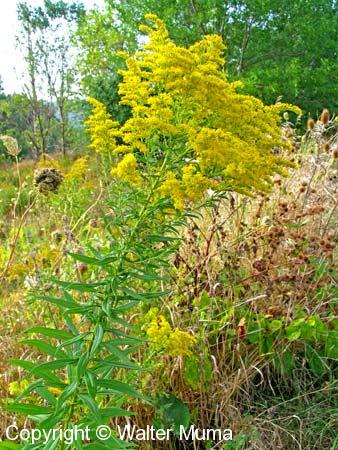
Canada Goldenrod is one of the most common Goldenrod species in Ontario. Yet in spite of this, it is probably the most difficult to identify with certainty! Here is its classic shape. Note the dense flowers. Mid September.
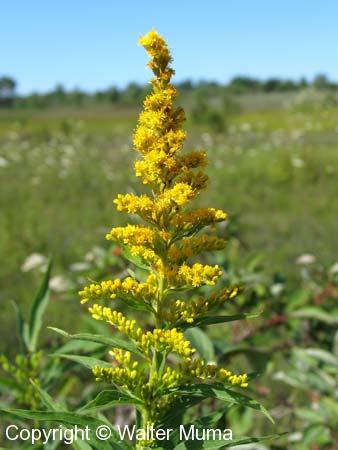
A more compact specimen.
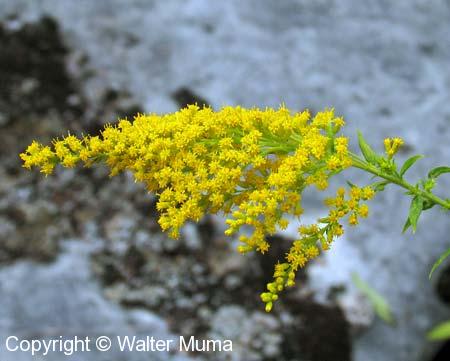
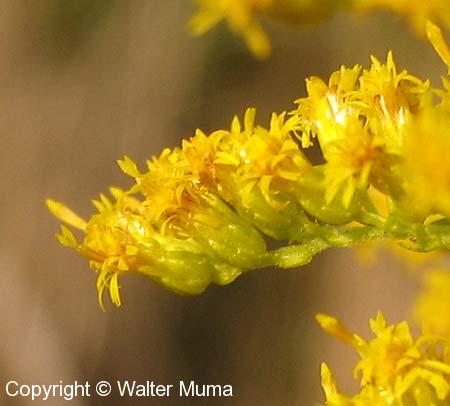
Close-up view of the flowers.
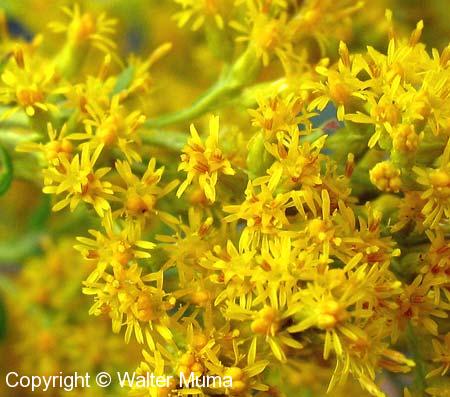
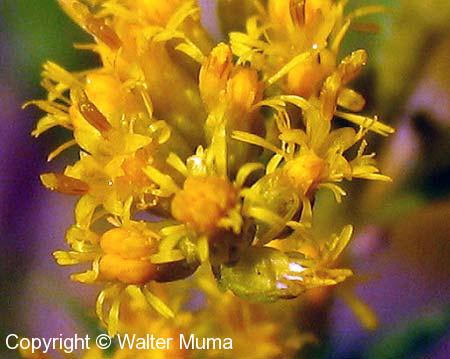
Am even closer view.
And again...
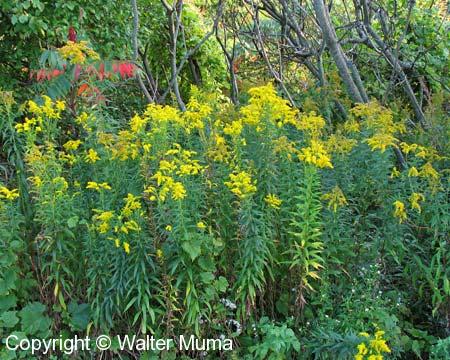
Here is a small stand of Canada Goldenrod. Note the classic shape.
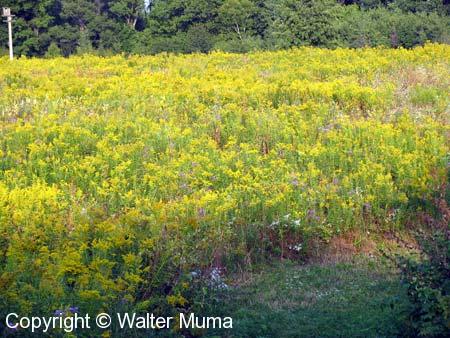
And a field of mostly Canada Goldenrod.
If you come across a large field of goldenrod like this, you probably won't be far off to say it's a field of Canada Goldenrod.
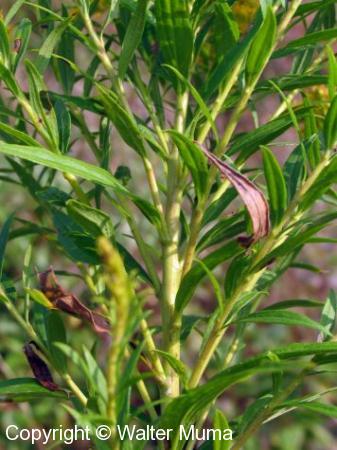
Canada Goldenrod has very numerous leaves all up its stem. This photo shows the upper stem and leaves, where the flower stems branch off.
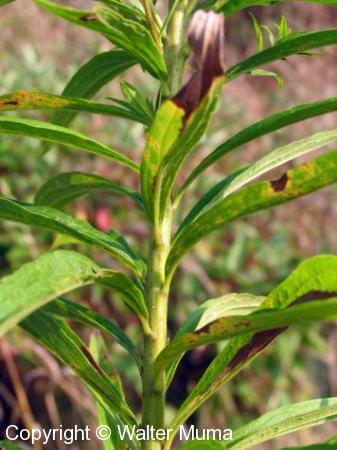
And here is the middle part of the stem - leaves still very numerous.
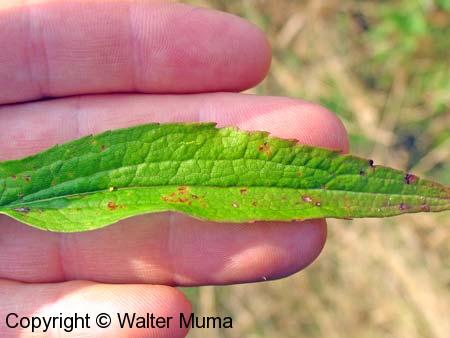
Leaves may be toothed ...
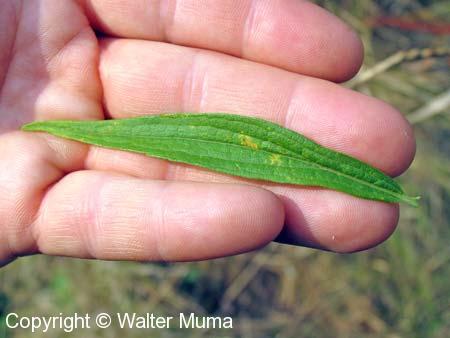
...or have entire (untoothed) edges.
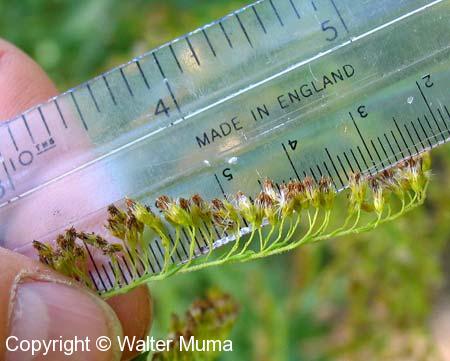
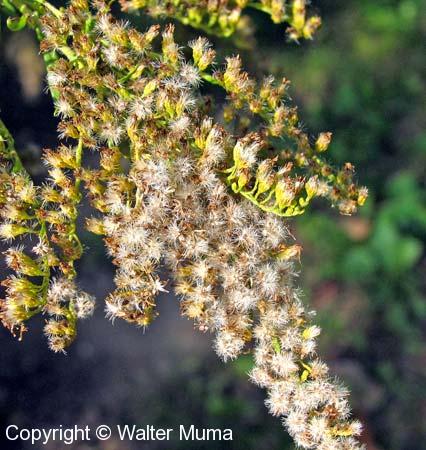
One of the key identifying characteristics of Canada Goldenrod is that the flowers are fairly small. Although the flowers in this photo have finished blooming, it still gives an idea of how small they are. Centimetres and millimetres are on the bottom of the ruler; inches (and tenths of inches) are across the top of the ruler.